
Jon Lubwama
posted on Jan 10, 2023Can Netflix's Cheaper Ad-supported Model Drive Market Penetration in Africa?
Over the first two quarters of 2022, Netflix lost 1.2m subscribers. This was the first decline in user numbers in a decade. The loss of subscribers is because of increased competition from other streaming services like Disney+, Amazon Prime Video, HBO Max and AppleTV+. Disney+, in particular, has emerged as Netflix’s strongest competitor.
As a counter to its poor performance in the first half of 2022, Netflix announced plans to introduce a cheaper ad-supported plan in late or early 2023 on top of its existing plans. Besides stopping the bleeding, Netflix believes it will be critical in the acquisition of new users in areas where its penetration is minimal, the chief of which is Africa.
Netflix does not release numbers of its African subscribers, preferring to group them into Europe, the Middle East and Africa monolith, which has 72.97 million subscribers in total, behind the US and Canada with 73.28 million. It is likely that Netflix groups Africa, the Middle East and Europe in one monolith because Netflix has a few users in the former two (Africa and the Middle East).
However, in 2021, Netflix’s subscribers in Africa were estimated at 2.6 million people and are projected to hit just 5.84 million in 2026. Netflix has struggled to acquire users in Africa, despite operating in the market since 2016. The estimated 2.6 million users account for just 0.2% of Africa’s 1.3 billion population and just 0.4% of Africa’s 590 million internet users.
What is an ad-supported business model?
The concept of an ad-supported business model is simple. It involves a content creator, a platform, an audience and then ads. For example, television stations and radio stations solely built their entire business around ads. They could create/licence content and build an audience and companies/events or service providers. Newspapers also sell ads, but they rely on newspaper sales.
The internet also gave rise to digital advertisement driven by companies like Facebook, Google and Amazon. Globally, the digital advertising market is projected to reach $616 billion by the end of this year, of which 42% will be search advertising (adverts on web pages that show search engine queries). The United States alone will generate most of the spending ($261.1 billion), and 69% of the total digital advertising spending will be through mobile by 2027, rather than desktop.
As we alluded to earlier, the major players in digital advertising are Google, Facebook and Amazon. The three internet giants control 65% of all internet ad revenue in the United States. Google and Facebook almost rely entirely on ad revenue. In 2021, ad revenue accounted for 82% of Google’s $256.73 billion 2021 revenue, while ad revenue made up 99% of Facebook’s $115 billion revenue last year. However, advertising revenue made up just 7% of Amazon’s revenue which makes more revenue from its other businesses like e-commerce and cloud services.
What Google, Facebook and Amazon did was quite similar to what radio and TV stations did. The internet giants built a service to attract users; a social media network for Facebook, a search engine for Google and an e-commerce marketplace for Amazon.
Digital advertising has also become a significant player in Africa. Most newspapers and news sites have migrated to digital publishing, maintaining websites alongside their newspaper, TV and radio station businesses. Most of these rely on Google Ads (Advertisers pay Google, and Google puts the ads on websites/YouTube videos). A few have advertisers of their own.
Platforms like Google, Amazon and Facebook make money when advertisers directly pay them. In Google’s case, it then places the ads in YouTube videos, online websites and apps and then shares the revenue with the content creators. Sometimes, online creators sidestep Google ads and negotiate advertisement deals directly with advertisers. This gives the creators more revenue because they don't have to share it with Google.
But the ad model has been criticised for killing the user experience. It is common for ads to be flashed across the screen as banner ads, in-content ads or even as full-screen ads that a user has to close. There are also privacy issues that users are wary of. Advertisers use data from the users to personalise the ads. This has led to the rise of ad blockers (software that stops ads). From 2015-2020, usage of ad blockers on mobile doubled from 282 million devices to 586 million per the 2021 Pagefair AdBlock Report.
Netflix co-founder, Reed Hastings, was one of the earliest critics of the ad-supported tier and introducing one is a significant shift in Netflix’s thinking. For a long time, Reed Hastings had opposed advertising, preferring subscriptions. To introduce ads, Netflix must figure out a partner, when and where to display the ads, and which ads to display for who. For a partner, it chose Microsoft, which was surprising given the dominance and experience of other would-be partners like Google, Facebook and Amazon.
What do we know about Netflix’s Ad-supported plan?
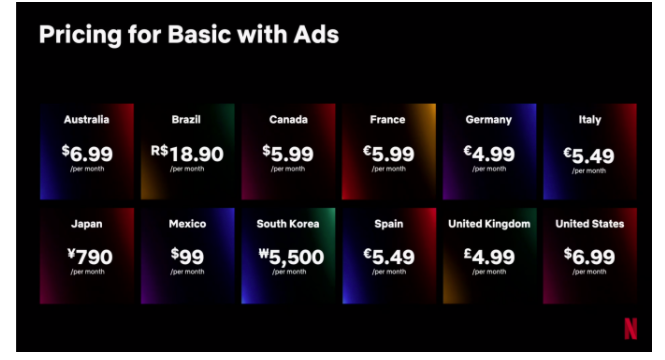
In early November 2022, Netflix’s plans for an ad-supported plan came to fruition. The plan, called Basic with Ads, was launched in a few markets across the world (no country in Africa yet) with different price points as shown in the illustration below.
In the USA, Basic with Ads will cost $6.99. This will be $13 cheaper than the Premium plan, $9 cheaper than the standard plan and $3 cheaper than the basic plan.
The ads will be 4-5 minutes worth of ads per hour and they will be before and during the movies and TV shows. However, the ads will last just 15-30 seconds long. Also, the new movies/TV shows will only have pre-roll ads, but the older movies/TV shows will have both pre and mid-roll ads.
Furthermore, subscribers of the Basic with Ads plan will stream lower-quality versions of the movies at 720p HD. Subscribers will also stream from one device only and will not be able to download content for offline viewing. They will also miss out on 5-10% of Netflix’s catalogue due to licensing restrictions.
At some point in 2023, Netflix will introduce this plan in Africa as part of its strategy to expand into a market where it has not had as much success as it has had in North America and Europe.
Will this cheaper plan drive market penetration?
To answer this question, we will need to look at the barrier to market penetration that a cheaper ad-supported plan will solve and its limitations, that is, the barriers that it will not solve. This will help us know how much the cheaper ad-supported plan will drive penetration.
The ad-supported plan will counter the low spending power of African consumers. Per the World Data Labs Consumer Spending Index, $13.7billion was spent every day by Africa’s 1.4 billion consumers in 2020, making Africa the world’s fourth largest consumer market behind Asia($85.5 billion), North America ($49.1 billion) and Europe ($39.3 billion). Whereas $13.7 billion might appear to be an astronomical figure, it was a per capita spend of just $9.8, the lowest in the world.
And the future appears bleak as well. African consumer spending will slightly improve by 2025 to $15.5 billion in total daily spending and $10.4 in per capita spending. The majority of Netflix’s users are millennials. The millennials are divided into two categories in the World Data Labs Consumer Spending Index: the Early Gen Z and Late Millennials (15-30 years) and the Early millennials (30-45). They have a per capita spending of $10.1 and $12.5, respectively.
What does this data mean? Most Africans do not have significant spending power, so paying for Netflix or any other video-on-demand service competes with paying for necessities like food, shelter, health and education. People will always choose to pay for the necessities over Netflix. However, if a plan is cheaper, then a few more people will be willing/able to pay for it.
But the cheaper ad-supported plan does not address many other challenges to Netflix’s penetration in Africa, including internet poverty. The true price of Netflix and other streaming services in Africa is probably the internet cost. In my case, I paid for Netflix (the basic plan of $7.99, but my internet budget had to go up to about $40 a month(to get unlimited monthly internet) from $28 to enjoy my subscription comfortably. And in most cases, the quality and speed of this internet is poor, rarely being faster than three megabits per second (3mps).
The World Data Labs (again) tracks internet poverty across the globe using three metrics: affordability, quantity and quality. To be classified as internet-poor, they will have to spend at least 10% of their disposable income to access 1 gigabyte of data per month at minimum download speeds of 3 megabytes per second. The number of internet-poor people using the above definition is 1.4 billion globally. Unsurprisingly, 58.3% (816 million) of these live in Africa.
Nigeria tops the list with 103 million internet poor, and it is joined by eight other African countries in the top 20, including Netflix’s other big market, South Africa, in 10th place with 38 million poor people. Another big market of Netflix, Kenya, is 21st on this list with 18 million internet-poor people. If the users can not access quality internet at an affordable price, then it will be hard for Netflix to penetrate the market despite its efforts.
What should Netflix do?
Telcos will be a key partner for Netflix to penetrate the African market. To reduce internet costs, Netflix will have to partner with telecom companies that provide internet across the continent. An example of how to do this would be YOTV, a Ugandan streaming service that costs $3 a month and partnered with MTN for YOTV internet bundles in February 2020.
One can stream for an hour at just UG shs. 500 ($0.13). Daily for shs 1000 ($0.26), Weekly for shs 2,500($0.65) and monthly for shs 10,000($2.58). By June 2021, the company’s CEO claimed to have surpassed 500,000 monthly subscribers citing the MTN partnership as a key driver.