
_brookingsSource.jpg?alt=media&token=941aa74a-5ef7-4d32-9911-8c7f767c54d1)
The future of India-Africa relations: Opportunities abound
Editor's Note:
Below is a viewpoint from the Foresight Africa 2022 report, which explores top priorities for the region in the coming year. Read the full chapter on Africa's external relations.
India and Africa’s historical links have experienced a revival in recent years, and there are strong reasons for optimism that the partnership could be mutually beneficial. In fact, in recent years, and especially during the COVID-19 pandemic, Prime Minister Narendra Modi’s government has made moves that indicate its intention for India to become Africa’s biggest partner.
Building on a growing trade and investment portfolio, India now has a strategy with clear guiding principles and areas of focus. The private sector is key to this strategy, particularly in the areas of skill and capacity-building initiatives, health care, agriculture, and the digital revolution. Moreover, underpinning the seriousness of India’s Africa policy shift, the country has made maritime security a key pillar in most of its engagement with countries like Kenya and South Africa.
But why would India be interested in Africa? Present mega trends in Africa are supportive of India’s trade and investments in the region. Africa’s large working-age population, its growing middle class, and the significant share of services are all ingredients for value adding trade and investment relationships. Consumer-driven goods related to agribusiness, apparel and clothing, pharmaceuticals, and automotive components are opportunities for India’s foreign direct investment (FDI) where Africa, through the African Continental Free Trade Area (AfCFTA), is putting in place the appropriate rules of origin to assure their optimization. Importantly, experts expect the African Continental Free Trade Agreement, which is already operational, to boost the levels of trade and investment, development of value chains, and industrialization across the region. The agreement is not only good for Africa: Concomitantly, it will provide a unified continental market that Indian firms can easily access and tap into—potentially increasing the scope and level of India’s engagement with Africa. And there is a lot of room for India in Africa: For example, Africa accounted for just 15 percent of India’s outward total investment stock between 2017 and 2019. In the same period, Mauritius, which is often used to re-route investments to third countries due to its favorable tax conditions, accounted for 82 percent of that number.
LOW-HANGING FRUIT FOR AFRICA-INDIA TRADE
The [AfCFTA] is not only good for Africa: Concomitantly, it will provide a unified continental market that Indian firms can easily access and tap into—potentially increasing the scope and level of India’s engagement with Africa.
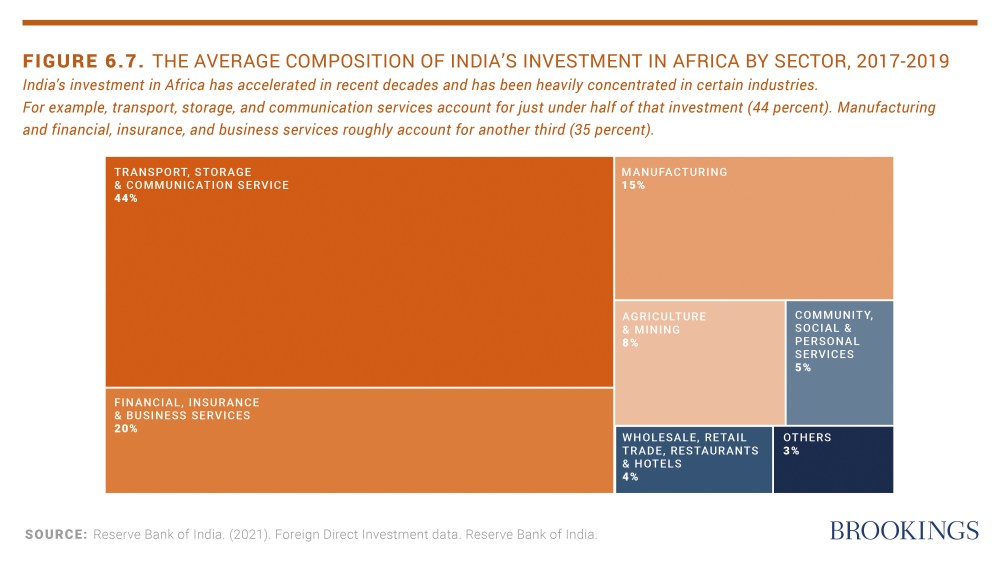
Recent Export Credit Agency (ECA) estimates suggest that gains from the AfCFTA will be pronounced in the agri-food and industrial sectors, hence creating additional opportunities for adding value to natural resources and diversifying into new business areas. Currently, India’s FDI flows to Africa are concentrated in the services sector, which accounts for almost 75 percent of the total (Figure 6.7). Increased FDI in the manufacturing sector by Indian companies could catalyze the development of value chains by providing foreign capital and technical know-how. In fact, a low-hanging fruit that can be exploited by Indian firms is the strengthening of the pharmaceutical manufacturing capacity in Africa. India is an important source of Africa’s pharmaceutical imports, but the pandemic revealed the adverse effects of international supply chains disruptions.6 India’s actions in restricting vaccines destined for COVAX-dependent countries may have made African countries question its commitment as a dependable partner in times of need, and for that, work is cut out for Indian diplomacy when it comes to the next India-Africa Forum Summit. The leadership of India together with South Africa in the proposal to waive certain provisions of Trade Related Aspects of Intellectual Property Rights (TRIPS), has been reassuring to developing countries. The sought waivers, if granted, could lead to increased production of vaccines in Africa, and India’s know how will be crucial.
Notably, India has emerged as an attractive destination for “medical tourism.” The number of African tourists visiting the country for medical treatment has increased almost threefold in the last decade, from 5.4 percent of the total tourist visits in 2010 to 15.4 percent in 2019. Continued collaboration between Indian health care providers and African partners, ranging from capacity building to establishment of hospitals and investment in telemedicine, is therefore necessary to engender universal health coverage. Moreover, India has signaled health care delivery will be key in its inclusive and transparent development model with Africa. The joint ventures in health care delivery call for education programs, including towards clinical research in the pharmaceutical sector. It is this ecosystem that will continue to make India a partner of choice for Africa when it comes to the health sector.
In a similar vein, knowledge transfer/lessons from the rollout and implementation of India’s biometric digital identification program—Aadhar—matters for African governments. If implemented effectively, digital identity can promote good governance by establishing clear institutional mandates and accountability mechanism and more. And the sharing of legal and technical advances on digital identity may help anchor Africa’s optimization of digital services trade and integration, an area where India is considered a world leader.
Differences in governance systems within the continent could undermine the development of a strong Africa-India partnership. Unlike in India where there is a homogenous governance system, Africa has a diverse and heterogenous system. However, the principles of multilateralism can play a crucial role in realizing a mutually beneficial relationship between India and Africa. Such cooperation will not only be important in dealing with global challenges, but also in defining solutions that offer opportunities for both the African and Indian people.
By: Stephen Karingi
Director, Regional Integration and Trade Division - United Nations Economic Commission for Africa
snkaringi
Laura N. Naliaka
Trade Policy Fellow, Africa Trade Policy Centre - United Nations Economic Commission for Africa